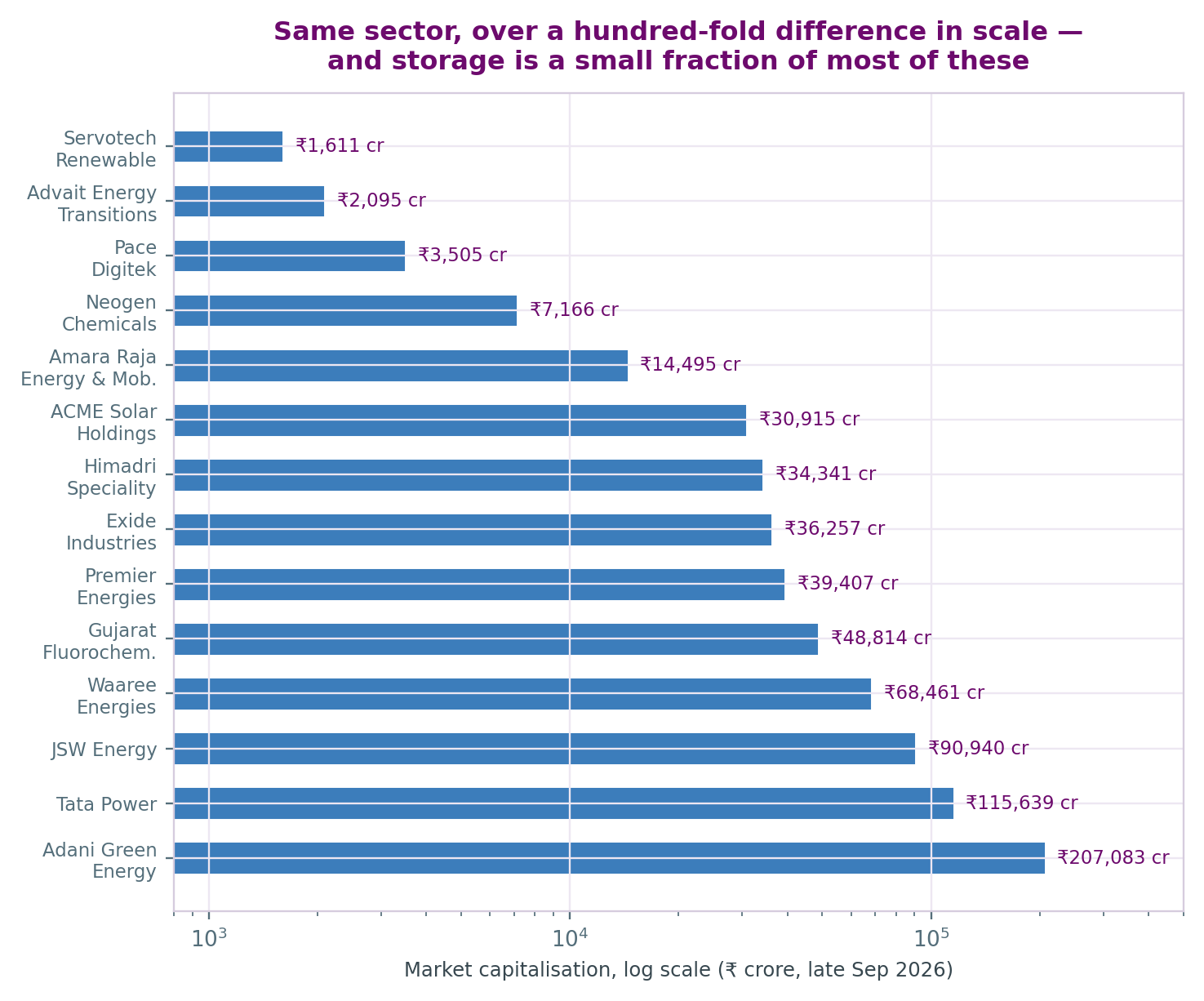
Fourteen NSE/BSE-listed companies carry the fullest, most direct exposure to this value chain today, from a ₹2.07 lakh crore renewable-power giant down to a ₹1,611 crore stabiliser-and-inverter maker whose grid-storage segment is, by the company's own admission, still "negligible." A further five names — Reliance Industries, NTPC, Ola Electric, the unlisted Tata subsidiary Agratas, and Prostarm Info Systems — matter to the sector's story but are covered here as context rather than as full reports, for reasons each entry explains. This is a wider net than the primer's first pass cast: a completeness audit conducted after initial publication added six names (Waaree Energies, Premier Energies, Adani Green Energy, Pace Digitek, Servotech Renewable Power and ACME Solar Holdings) that a tweet-anecdote-driven company list had missed, and moved one candidate (Prostarm) to context after research found it had just abandoned its one dedicated grid-BESS initiative. Market capitalisation, on its own, tells you almost nothing about how central grid storage actually is to a company's business, which is the first thing to sort out before any ratio in the individual company reports means anything.
Splitting the fourteen by how central grid storage actually is to the business — based on segment disclosure where a company breaks one out, and on revenue/capex proportion where it does not — produces a picture this sector's headlines rarely admit to:
| Grid storage is the strategic identity | Grid storage is one bet among several |
|---|---|
| Advait Energy Transitions — legacy transmission EPC still 63% of FY26 revenue, but the company is explicitly repositioning around BESS and green hydrogen, and is priced by the market almost entirely on that story | Exide Industries — EESL's Li-ion plant just commissioned, but lead-acid is still ~90%+ of group revenue today |
| Pace Digitek — energy/BESS was 90% of FY26 order inflow and management guides to 55% of FY27 revenue, against a legacy telecom-infrastructure base now firmly in the minority | Amara Raja Energy & Mobility — New Energy crossed ₹200cr in a quarter for the first time in FY26, against ~₹3,400cr quarterly group revenue |
| JSW Energy — 3.2 GWh of locked-in BESS against 26.4 GWh of pumped-hydro storage and 32.4 GW of total locked-in generation capacity | |
| Gujarat Fluorochemicals — battery materials is a loss-making, low-single-digit-percent segment inside a much larger, profitable fluorochemicals business | |
| Himadri Speciality Chemical — battery materials is pre-revenue-scale, and management capital/attention is simultaneously being spent on an unrelated Birla Tyres acquisition | |
| Neogen Chemicals — battery chemicals is the fastest-growing segment by percentage, but from a tiny base inside a bromine/pharma-intermediates business | |
| Tata Power — storage is not even a separately disclosed segment inside a ~₹68,000cr-revenue integrated utility | |
| Waaree Energies — a board-approved 16 GWh battery gigafactory sits alongside a much larger, longer-established solar module/cell business (₹26,537cr FY26 revenue) | |
| Premier Energies — a named non-Chinese BESS technology JV (RCT Solutions) is still a binding term sheet, layered on a solar-cell-export business several times its size | |
| Adani Green Energy — a genuinely large 3.37 GWh Khavda BESS sits inside a ~20 GW+ generation fleet targeting 50 GW by 2030; no BESS-specific revenue is disclosed | |
| ACME Solar Holdings — FDRE/storage is the forward-pipeline growth story, but 2,890 MW of current operating capacity is still overwhelmingly plain solar and wind | |
| Servotech Renewable Power — BESS is explicitly "negligible" against a solar-dominated (94.8%) revenue mix as of the most recent quarter |
Source: Dart Consultants, from company segment disclosures gathered for each company's own report (see part 4). Where a segment split is not itemised, proportion is estimated from disclosed capex, capacity or subsidiary-revenue figures and flagged as such.
Unlike sectors where the identity-play and the diversified-conglomerate-play are evenly split, this sector currently has very few of the former. That is itself a finding: India's grid-storage build-out is being financed, for now, mostly out of the balance sheets of much larger businesses for whom storage success or failure will not move the stock on its own — which means the company reports that follow spend as much time establishing how big this bet actually is as they do assessing whether it is a good one.
| Company | Ticker | Primary value-chain layer | Listing note |
|---|---|---|---|
| Exide Industries | EXIDEIND | Cell manufacturing (Li-ion, via EESL) + legacy lead-acid | Long-listed; SVOLT-licensed 6 GWh Phase-I commissioned 23 Sep 2026 |
| Amara Raja Energy & Mobility | ARE&M | Cell manufacturing (Li-ion, planned) + legacy lead-acid | Renamed from Amara Raja Batteries, Sep 2023; Gotion tech deal stalled, gigafactory delayed to FY27/28 |
| JSW Energy | JSWENERGY | BESS deployment (IPP/EPC) + pack assembly (JEPEL) | Long-listed; COEP cell-R&D MoU signed by a separate JSW Group entity, Sep 2026 |
| Advait Energy Transitions | ADVAIT | BESS cell-to-container assembly + EPC | Renamed from Advait Infratech, Oct 2024; Hithium cell-supply MSA, Sep 2026 |
| Gujarat Fluorochemicals | FLUOROCHEM | Materials — LiPF6 electrolyte salt + LFP cathode | Long-listed; battery materials a small, loss-making segment to date |
| Himadri Speciality Chemical | HSCL | Materials — LFP cathode + graphite/silicon-carbon anode | Long-listed; also diversifying into Birla Tyres (unrelated to batteries) |
| Neogen Chemicals | NEOGEN | Materials — electrolyte + LiPF6, via Morita JV | Long-listed; CRISIL downgraded battery-chemicals subsidiary, Jul 2026 |
| Tata Power | TATAPOWER | BESS / pumped-storage deployment (IPP/EPC) | Long-listed; storage a small, non-disclosed ancillary business |
| Waaree Energies | WAAREEENER | Cell manufacturing (planned, 16 GWh) + solar module/cell core | Long-listed; battery-entity structure (Rambilli vs. "Waaree ESS") unreconciled in public disclosure |
| Premier Energies | PREMIERENE | BESS manufacturing (JV, 12 GWh) + solar cell/module core | Long-listed; RCT Solutions (Germany) JV — the only named non-Chinese tech partner in this report |
| Adani Green Energy | ADANIGREEN | BESS deployment (IPP) + renewable generation | Long-listed; 3.37 GWh Khavda BESS commissioned, but storage revenue undisclosed |
| Pace Digitek | PACEDIGITK | BESS pack/container manufacturing + legacy telecom infra | Mainboard IPO, Oct 2025; flagship order's per-MWh pricing unreconciled |
| Servotech Renewable Power | SERVOTECH | BESS manufacturing (small-scale) + solar/EV-charging core | Long-listed; Chinese tech partner (Zhuhai Piwin); BESS revenue currently negligible |
| ACME Solar Holdings | ACMESOLAR | BESS/FDRE deployment (IPP) | Long-listed; storage-integrated pipeline growing fast off a still-small operating base |
Amara Raja's core grid-storage differentiator has already failed once. Its licensing agreement with China's Gotion (via GIB EnergyX, signed June 2024) was the company's stated path to a competitive LFP cell technology; per its own New Energy Business head, it "has not moved ahead due to geopolitical reasons," and the flagship Telangana gigafactory has slipped from an original end-2025 target to FY27/FY28. Advait Energy Transitions is a grid-storage story built almost entirely on events from the last twelve months — a company name change (October 2024), a single Chinese cell-supply agreement with Hithium (September 2026) covering under half of its planned facility's year-one nameplate capacity, and a stock with zero institutional brokerage coverage found in this research. Pace Digitek's single largest named BESS order does not add up. A ₹488.46 crore contract stated as covering "5.015 MWh" implies a price roughly 100 times the company's own, contemporaneous Kalpa Power order and roughly 100 times its own FY26 delivery economics — every outlet checked repeats the same figure, consistent with all of them republishing one press release rather than verifying it, and the primary exchange filing could not be accessed to resolve the discrepancy. Waaree Energies discloses two battery businesses that do not obviously reconcile — a board-approved ₹8,175 crore, 16 GWh Rambilli gigafactory, and a separately-reported, already-operating "Waaree Energy Storage Solutions" line (5.15 GWh, funded by a distinct ₹1,003 crore family-office/HNI raise) building toward 20 GWh — with no public source clarifying whether these are the same project under two names, one a subset of the other, or genuinely separate initiatives. None of these four points makes the underlying stock uninvestable; each is exactly the kind of structural detail this report exists to surface rather than gloss over. Full 9-page reports for each of the fourteen companies — financials, governance assessment, SWOT, valuation and rating — follow this primer; see each company's own report for the fullest, most current picture.