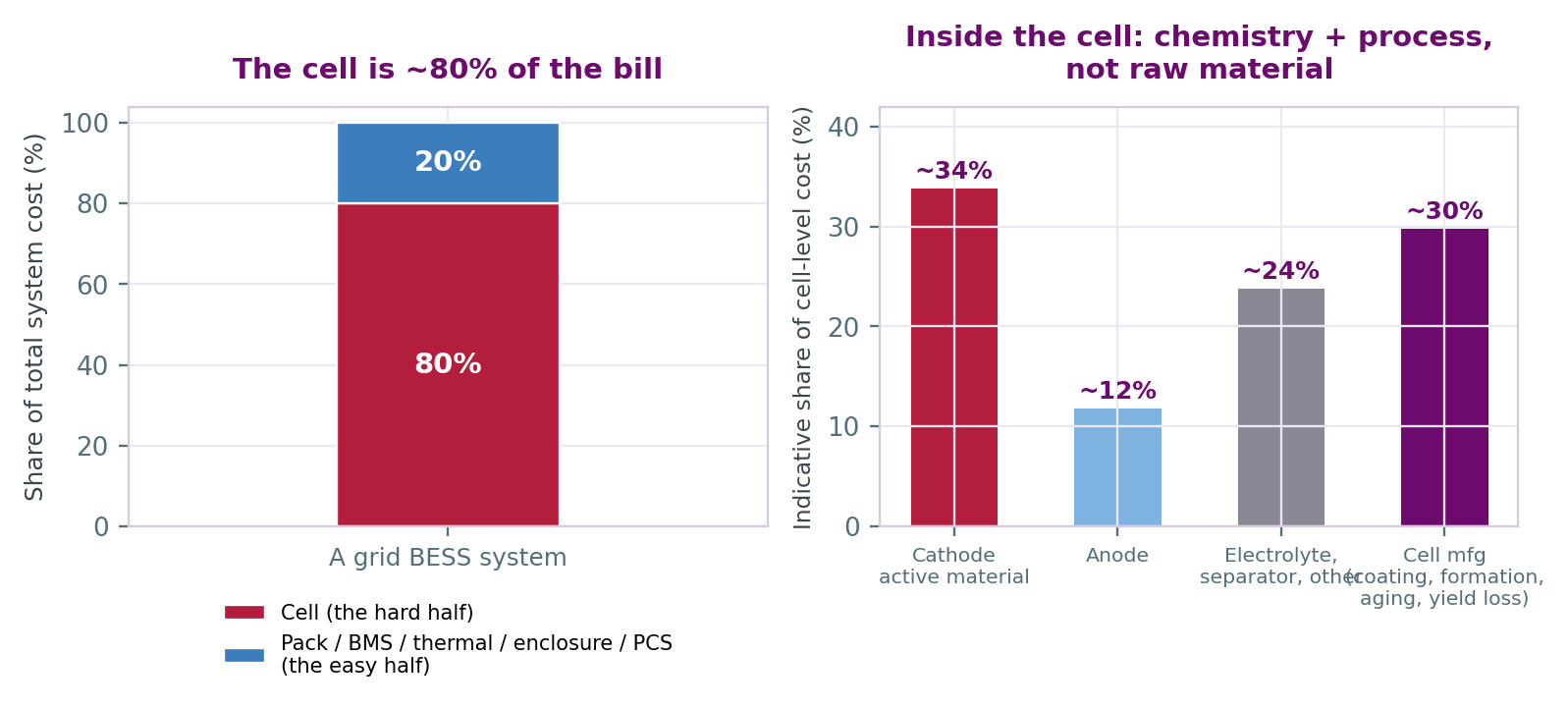
Three reasons the hard half does not scale the way the easy half does.
A commissioned container's success criterion is a measurement you take today: does the grid-code test pass, does the inverter synchronise, does the BMS balance the pack. A cell's success criterion is the absence of a failure that only shows up after years of cycling — capacity fade beyond spec, a safety margin that was never really there. You cannot inspect your way to confidence here; you can only control the coating, calendaring and formation process tightly enough, and accumulate enough of your own field data, that a customer trusts the absence of an early failure as a proxy for twenty years of it.
A gigafactory does not open at rated yield. Formation and aging — the multi-day-to-multi-week first charge-discharge sequence — is where the industry's own process literature places roughly 70% of back-end capital expenditure, and it is the stage where latent defects (micro-shorts, gas generation, early capacity fade) actually surface and get scrapped. Climbing from first cells off the line to a commercially competitive yield typically takes a new entrant one to two years of continuous process learning — not a one-time audit, but a compounding experience curve that an incumbent with a decade's head start simply has more of.
A developer who qualifies a cell supplier for a 20-year BESS asset is underwriting that supplier's process control for two decades on the strength of, at best, a few years of field data. Having made that bet once, a customer has every incentive not to repeat it for a marginal price improvement from an unproven second source — which is exactly why, once a cell is designed into a programme, switching is structurally difficult, independent of whether a patent exists (for LFP, there is not one).