If the cell is this hard to make, why does an Indian EPC contractor with zero cell-manufacturing capability get any grid-storage revenue at all? Because China is currently happy to sell India the finished cell — in record volumes, at prices that fell to a global record low of $108/kWh (pack average) in 2025 — while restricting the export of the process know-how behind it. The "free input" here is the imported cell itself: someone else has already solved the hard half, and is renting out the finished product at a globally competitive, still-falling price. This is precisely why India installed 8.2 GWh of grid batteries in the first half of 2026 — 84 times the prior year — while its own operational cell-manufacturing capacity covered under 1% of the demand pipeline behind that build-out. Advait Energy Transitions' September 2026 supply agreement with China's Hithium, covering up to 1 GWh of cells for a 2.5 GWh BESS assembly plant it is building in Gujarat, is this dynamic in miniature: the cell is for sale; the recipe is not part of the deal.
The alternative — actually licensing or building the cell-manufacturing process — inverts this entirely. It requires the capital, the dry-room infrastructure, and years of yield-curve learning that §3 describes, and as of July 2025 it also requires a Chinese export licence for the specific compaction-density and process technology that separates a competitive LFP cell from a mediocre one. Every serious Indian conglomerate named in this report is trying to walk through that second, harder door, at very different speeds — and, as the company reports that follow show in detail, with very different results.
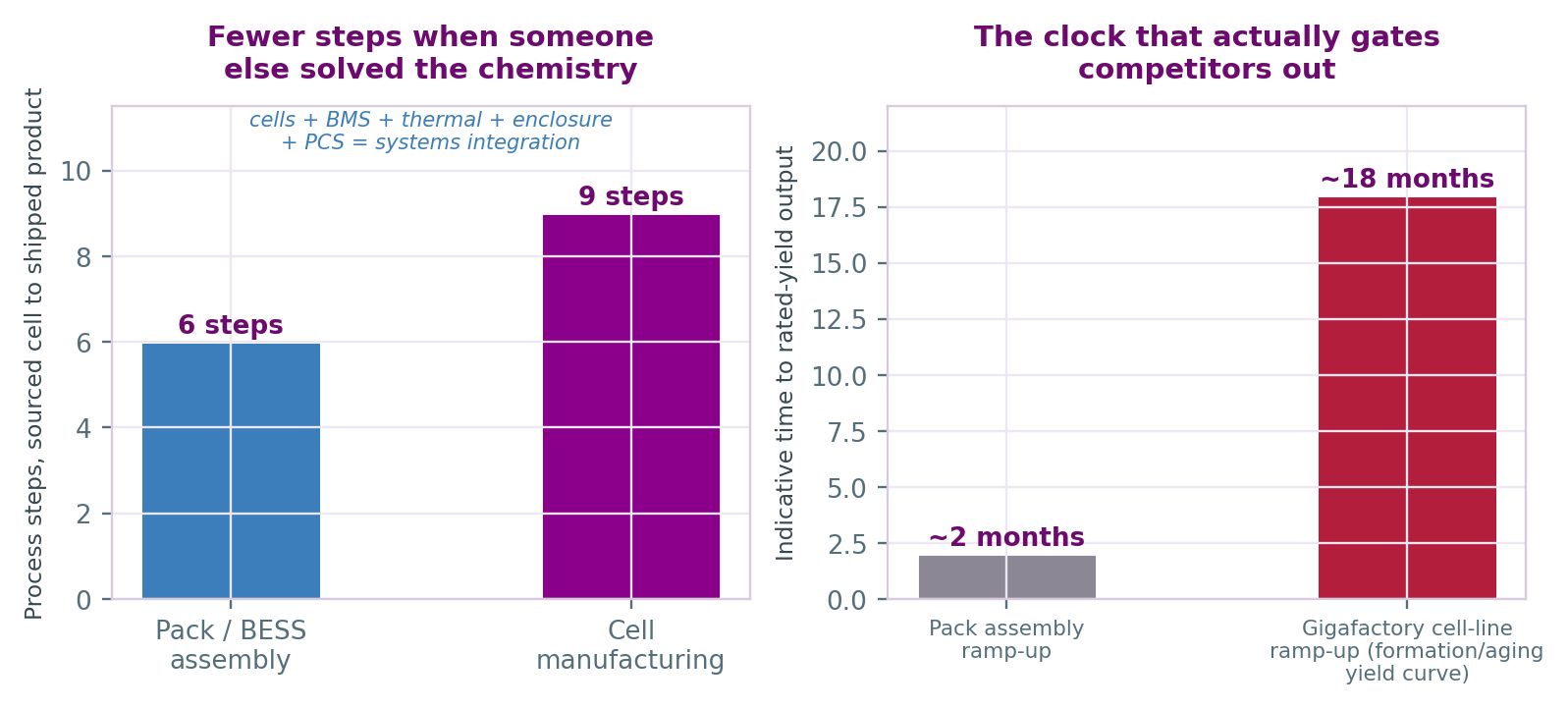
When a company report later in this document describes a business as "cell-to-container assembly" or "BESS EPC," read that as: mostly the easy half, real revenue today, thin and contestable margin. When it describes a business as holding a licensed or in-house cell-manufacturing process — and names a compaction-density spec, a formation protocol, or a multi-year yield ramp — read that as: closer to the hard half, and worth asking whether the licence behind it actually survived contact with China's July 2025 restriction. Two of this report's fourteen companies signed cell-technology deals with Chinese licensors at different points either side of that restriction tightening — one succeeded, one stalled — and the contrast is the single clearest real-world illustration of this entire section. See §9.